Fensham, R., Summer, T. D., Cutter, N., Buchanan, G., Liu, R., Munoz, J., Smithies, J., Zheng, I., Carlin, D., Champion, E., Craig, H., East, S., Hay, C., Given, L. M., Macarthur, J., McMeekin, D., Mendelssohn, J., & van der Plaat, D. (2024). Towards a National Data Architecture for Cultural Collections: Designing the Australian Cultural Data Engine. Digital Humanities Quarterly, 18(2). https://www.digitalhumanities.org/dhq/vol/18/2/000678/000678.html
This article summarises the aims, methods, information architecture, outputs, and innovations of the Australian Cultural Data Engine (ACD-Engine), a project that harnesses leading cultural databases to build bridges to research, industry, and government. The project investigates digital heritage collections, data ontologies, and interoperability, building an information architecture to enhance the open sharing of Australian cultural data. Working with a cross-disciplinary team, the ACD-Engine establishes conceptual and technical frameworks for better understanding the platforms and uses of cultural data across a range of national and international contexts. This new cyber-infrastructure advances cultural data aggregation and interoperability whilst prioritising data quality and domain distinctiveness to answer new research questions across disciplines. As such, the ACD-Engine provides a novel approach to data management and data modelling in the arts and humanities that has significant implications for digital collections, digital humanities, and data analytics.
In the chapter entitled ‘DH-XR: Extended Reality’s Relevance to the Digital Humanities,’ Professor Erik Champion of the University of South Australia and Dr Hafizur Rahaman of Curtin University explore the use of digital technology in the dissemination of cultural heritage. They cover 3D models, virtual/extended reality, and game design and discusses issues and challenges involved in these technologies. They also introduce immersive (digital) literary as a relevant learning skill for cultural heritage in this digital age.
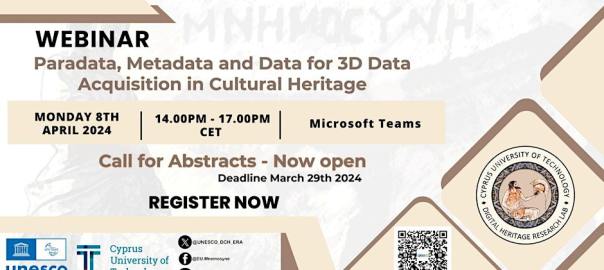
I was invited to present online my thoughts on paradata and metadata in digital heritage today, a free webinar run by the UNESCO chair of digital cultural heritage staring 2PM Central European Time. More details are here. Talks are 10-15 minutes each…
14:00-14:10 Harry Verwayen DG. Europeana Foundation. NL Opening remarks 14:10-14:20 Marinos Ioannides, et al UNESCO Chair on DCH at Cyprus University of Technology. CY Paradata, Metadata & Data for a digital #MemoryTwin 14:20-14:35 Isto Huvila Invited KEYNOTE Uppsala University. SE Datafication of archaeological archiving and the preservation of what? 14:35-14:50 Luisa Ammirati, et al UNOSAT/UNITAR. CH, UNESCO WHC, FR Paradata and metadata in an immersive digital heritage experience 14:50-15:05 Erik Champion University of South Australia. AU Usable, Useful, Reviewable and Reusable Metadata 15:05-15:20 Carla Schroer, et al Cultural Heritage Imaging (CHI). US Building Reliable and Reusable Complex Digital Representations: The Digital Lab Notebook 15:20-15:35 Daniel Pletinckx Visual Dimension bvba. BE 3D Heritage is Heritage, we should treat it as such 15.35-15:50 Tony Cassar, et al Heritage Malta. MT Challenges of 3D Digitisation of Cultural Heritage 15:50-16:05 Shuyi Yin, et al Columbia University. US Blockchain Technology for Enhanced Documentation and Management of Built Heritage in Historic Cities 16:20-16:35 Jean-Baptiste Barreau Archéologie des Amériques (ArchAm), CNRS. FR Three-Dimensional Reconstruction of an Egyptian Saqiya: A Computational Approach to Preserving Cultural Heritage and Water Management Systems 16:35-16:50 Antoine Isaac, et al Europeana Foundation. NL Making the Europeana Data Model a better fit for documentation of 3D objects 16:50-17:05 Raffaella Brumana, et al Politecnico di Milano. IT HBIM quality information model to manage surveying, stratigraphic units and transformations into paradata. The mausoleum of Cecilia Metella and the Castrum Caetani 17:05-17:30 Discussion Session & Closing Remarks
Intangible and tangible heritage are two sides of the same coin, perhaps. It has been a great step forward for UNESCO to add the concept of intangible heritage, but I can’t help but feel heritage is the relationship between the two. How can digital heritage help re-span this gap?
NB isn’t “cultural heritage” saying the same thing twice? Oh yes, there is industrial heritage, but as soon as it becomes heritage it achieves some form of cultural status…
There are intern (unpaid, sorry) projects available at IVE UniSA (and at University of Auckland).
I’m excited to announce the launch of the 2024 virtual intern program for the Empathic Computing Laboratory and IVE AR/VR research centre.
We have 21 great projects in AR/VR/XR, brain computing interfaces, AI, etc that you can do without leaving home.
Apply now and get the chance to work and publish with some of the best researchers in the world. See https://lnkd.in/g-WFSeJ
by Mark Billinghurst
I have 2 projects listed (at the end of the PDF):
VIP Project List- March 2024
Project 20: 3D and panoramic interactive viewer
Review software (preferably open access and low cost) that can offer interactive and interesting ways to combine 3D models and panoramic backgrounds. Ideally the 3D model or aspects of the panorama can communicate with the viewer and / or with each other. Ideally the software can be modified and works across a variety of platforms. To give you an idea of recent related work, this paper examines software for historic architecture “Outside Inn: Exploring the Heritage of a Historic Hotel through 360-Panoramas” MDPI Heritage 2023, presentations using 3D: https://www.mdpi.com/2571-9408/6/5/232
Student Skills and Background:
● Essential: ○ Experience with 3D media, panoramas and html scripting
● Desirable: ○ JavaScript
Expected Deliverables: ● Project leading to an academic publication and working proof of concept
Project Duration: 3 – 6 months IVE collaborators: Erik Champion
Project 21: Augmented Reality Workflows and Prototype Tools for Museums
Develop a simple and clear visual workflow or software wizard to provide non-programmers from the museum sector a way to visualize how their historic collections can be interacted with via AR phone-based software, ideally software that does not require downloading specialised apps (for example, works in the browser). It is ideally useful for android or apple phone-based operating systems, and allows for interactivity. The aim is to use this tool or schema in workshops with museum (GLAM) people to help them develop AR-based games even if they don’t have programming or interaction design experience. A way to gather data on how the tool or examples could be used would be an added benefit.
Student Skills and Background:
● Essential: ○ Skills in diagrams or mockups
● Desirable:
○ Interest in Augmented Reality for Android or Apple or other.
○ Interest in interaction design/user experience design Expected Deliverables:
● A workflow, a demo, and material for possible academic paper for a conference or a journal.
Project Duration: 3 – 6 months IVE collaborators: Erik Champion
In “Chapter 19: Digital Humanities and Visible and Invisible Infrastructures” by Gimena del Rio Riande, the chapter declared on page 249:
They recall how already by 2014, following Karen Knorr- Cetina in 2001 (“Objectual Practice”), Erik Champion (“Researchers as Infrastructure”) had anticipated the emergence of DH infrastructures as dynamic ecosystems. These works could give anyone the impression that technology is always one and identical, that its users speak the same language, that institutions are run in the same way globally, and that we all have the same degree of digital literacy.”
My point about scholaly ecosystems was that students, teachers and users are vital parts of these digital ecosystems if they are to be ecosystems (not just a range of products). The audience has to be actively involved (“give the impression”) for the good of both parties. Given this, (and the writer probably does not know I am from one of the least populated and remotest countries in the world with non-European heritage), there is no way an objective and prescient reader of my works could be led to believe or try to persuade anyone that I promote a homogenous and universal digital infrastructure.
I do however believe in interoperability, shared transactional frameworks and some form of freemium system as a balance between public access and shareholder rights.
I am not sure why fake polemic battles are needed.
Reference:
del Rio Riande, Gimena (2022). Digital Humanities and Visble and Invisible Infrastructures. In Global Debates in the Digital Humanities. (USA): University of Minnesota Press.
Athough I am increasingly concerned with the logistics and environmental cost of longdistance travel I have agreed to visit Belgium for the last week of February for research administration reasons. I arrive a day early and heritage researchers were kind enough to offer to meet me at the University of Antwerp, I may give a lecture or feedback on staff and student papers. I’ve never had the opportunity to visit beyond Brussels (and Ghent remains on my wish list) so to get a chance to visit Antwerp and talk digital heritage is rather wonderful. Happy to talk to any like minded souls on some of the potential challenges and issues.
Last November I was invited to give game design workshops (and talks) in Norway and Iceland (and talks in England and Wales) in October and then I visited Norfolk Island in December. Hopefully for a future research grant application. Very exciting way to finish 2023.
Champion, E., & Emery, S. (2024). Galleries, Libraries, Archives, and Museums [GLAM]-focussed Games and Gamification. In J. Nichols & B. Mehra (Eds.), Data Curation and Information Systems Design from Australasia: Implications for Cataloguing of Vernacular Knowledge in Galleries, Libraries, Archives, and Museums (Vol. 54, pp. 67-83). Emerald Publishing Limited. https://doi.org/10.1108/S0065-283020240000054006.
Engaging with digital heritage requires understanding not only to comprehend what is simulated but also the reasons leading to its creation and curation, and how to ensure both the digital media and the significance of the cultural heritage it portrays are passed on effectively, meaningfully, and appropriately. The United Nations Educational, Scientific, and Cultural Organization defines ‘digital heritage’ to comprise of computer-based materials of enduring value some of which require active preservation strategies to maintain them for years to come.
With the proliferation of digital technologies and digital media, computer games have increasingly been seen as not only depicters of cultural heritage and platforms for virtual heritage scholarship and dissemination but also as digital cultural artefacts worthy of preservation. In this chapter, we examine how games (both digital and non-digital) can communicate cultural heritage in a galleries, libraries, archives, and museums [GLAM] setting. We also consider how they can and have been used to explore, communicate, and preserve heritage and, in particular, Indigenous heritage. Despite their apparently transient and ephemeral nature, especially compared to conventional media such as books, we argue computer games can be incorporated into active preservation approaches to digital heritage. Indeed, they may be of value to cultural heritage that needs to be not only viewed but also viscerally experienced or otherwise performed.
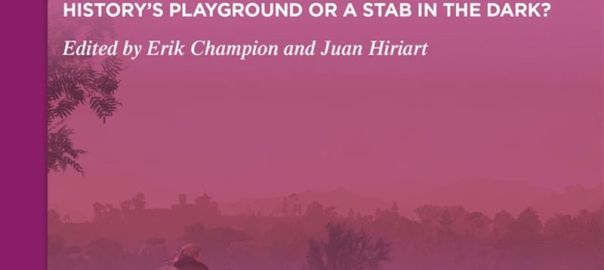
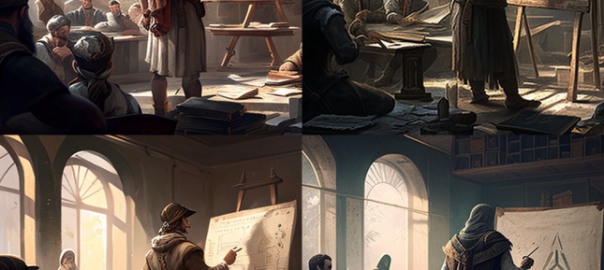
Assassin’s Creed‹ in the Classroom History’s Playground or a Stab in the Dark? HAS been published by De Gruyter, on 18 December. Thanks to my co-editor Dr Juan Hiriart, and our authors.
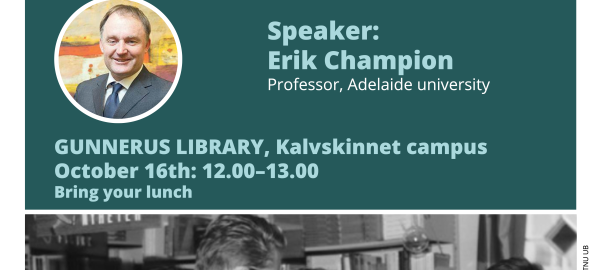
The eCHOing project is inviting you to a lunch lecture, join us for an exciting event that explores the fascinating world of visitor experiences in the GLAM sector (Galleries, Libraries, Archives, and Museums). Photo: gunnerus.no NTNU UB
TUESDAY17 OCTOBER Hands-on Game Design Workshop, TRONDHEIM NORWAY, 09:30-14:30
Join us for an exciting event that explores the fascinating world of visitor experiences in the GLAM sector (Galleries, Libraries, Archives, and Museums).
Whether you’re a student curator, librarian, archivist, or museum enthusiast, this event is a must-attend to stay ahead in the ever-evolving GLAM landscape.
In this half-day workshop Erik Champion will help small groups of 4 brainstorm (“ideate”) ideas to create engaging games using a simplified working definition of computer games, and with the help of physical items. Although these game ideas could eventually become digital games, escape rooms, augmented or mixed reality projects, this introductory workshop will concentrate on creating and testing physical (analogue) demos and simple prototypes. Although Erik’s focus has been on history and heritage games, this workshop will be open to other types of games, but particularly on those where players can learn beyond the game, and where the game is a series of engaging challenges. You may bring your own idea for a game, or develop a game idea on the day in a group. No programming necessary.
Work in interdisciplinary groups with real life problems
Be an agent of change as your ideas will help professionals reach a wider audience for their cultural institutions!
Learn the fundamentals of serious games and why so many fail.
Discover how paper prototyping in groups can help you quickly create engaging game ideas.
Short bio for NTNU workshop
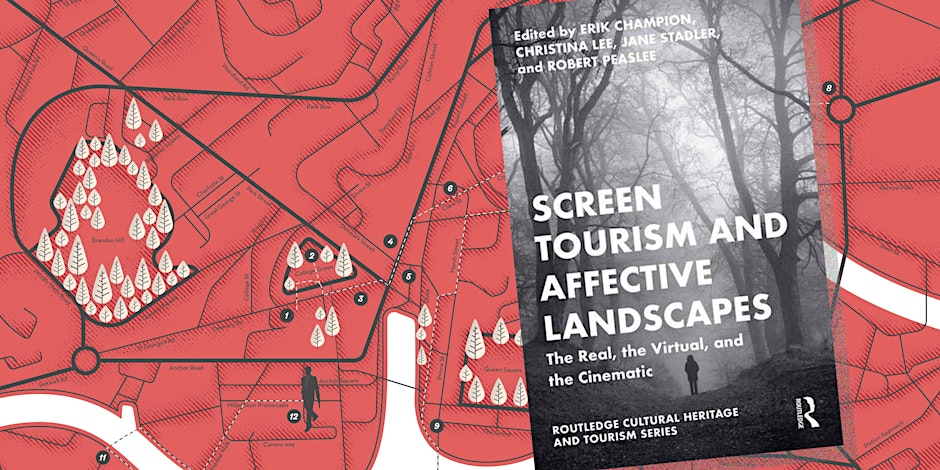
Erik Champion tutors game jam projects in South Australia at UniSA, and has hosted game design workshops in Australia, Italy, Poland, the United States, Qatar, and Finland, and co-hosted remotely a game design workshop with school children in Rapa Nui (Easter Island) with Dr Juan Hiriart. He is currently working on research projects with Tencent Games and Ubisoft. He wrote Playing With The Past: Into The Future (Springer 2022), and edited the open access book Virtual Heritage: A Guide (Routledge, 2021) and has written books on the intersection between video games and cultural heritage. He has honorary appointments at Curtin, UWA, and ANU and was recently a visiting professor at the University of Jyvāskylā, Finland, a partner of the Centre of Excellence in Game Studies (https://coe-gamecult.org/).
Skills required: none.
The eCHOing project is an EU-funded programme that aims to foster collaboration through open innovation between universities and 29 cultural institutions in five European countries. Don’t miss out on this unique opportunity to gain valuable insights from our invited gaming guru and writer of the book PLAYING WITH THE PAST.
WEDNESDAY18 October MediaCity, Salford University, MANCHESTER, ENGLAND, UK, 15:00-19.00
This talk will examine how key challenges in digital heritage involving 3D models could be brought to life and re-opened to interpretation by game design, and how game-like interaction could also help increase the richness and immersive qualities of XR (extended reality) and virtual tourism. Can 3D models, the scholarly information surrounding them, and the involvement of the public be brought closer together? And can we harness the speed and complexity of new technologies to ensure both the data and our understanding of that data can be recorded, interpreted, and shared more fairly, openly, and democratically?
Reflective Experiences with Immersive Heritage (Difficult Digital Heritage)
Despite the growth and spread of digital humanities visualisation projects, parallel and accessible examples in immersive virtual heritage are harder to find. Over the last three decades, immersive technologies (especially as “new” media) have embraced digital heritage to create spectacular experiences, but existing and durable examples of virtual heritage (virtual reality applied to cultural heritage) are relatively rare, while examples of difficult heritage far rarer. In this talk I will summarize relevant dilemmas in presence research, and recent developments in virtual heritage, reflect on some difficult lessons learnt, and offer some recommendations as to how we could address the depiction or evocation of difficult pasts in the near future.
BIO
Erik Champion is an Enterprise Fellow at UniSA, Emeritus Professor at Curtin University, Honorary Research Fellow at UWA, and Honorary Research Professor at ANU. He has published books and papers on serious games and game mods, virtual heritage, virtual world phenomenology, digital humanities infrastructures, and architectural history.
I am delighted to share a call for a new StoryLab Research Fellow in Creative Technologies and Immersive Storytelling and would be grateful if you could share it with your networks and colleagues who you think might be interested in applying.
This is a full time fixed-term 24-months contract. Deadline for applications: 16th October 2023.
I am looking for a new member of StoryLab who will work on a range of digital and/or immersive experience (XR) practice-led projects, and will develop new research that contributes to StoryLab’s research themes (Human Creativity, Design and Technology; Identity, Culture and Heritage; and Sustainable and Resilient Communities).
Partnering with the Adelaide Gaol, we are looking for a PhD student to explore a project that looks at tourism of places with challenging histories in respectful and personalised ways using Augmented Reality.
You need to be eligible to complete a PhD to apply and you can find the eligibility requirements link at the bottom of the UniSA Project Page.
I’m sorry I have not been updating this blog very frequently.
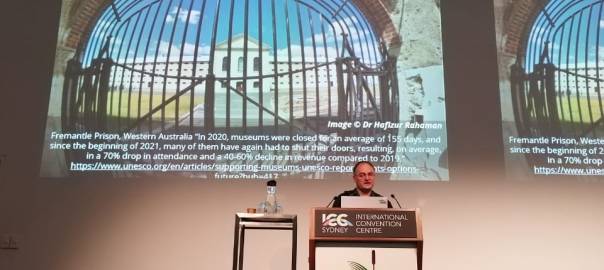
I spent a week in Sydney (at my expense but for a good cause): ICOMOS. I am a member of ICIP ICOMOS but to be honest I don’t seem to be very involved or I don’t know (currently) what is happening. They had their meeting as I was travelling to ICOMOS General Assembly, we co-chairs of the Scientific Symposium had to meet at 7.30 every day and Tuesday and Thursday was a full on Digital Heritage program that I have mixed feelings about.
The concerns I have about Digital Heritage seem shared by the others, but I only had 15 minutes to talk and they decided (because of others, and the screen having to reset) that there were no Q&A for my session. I think in future I will work with more specialist audiences at smaller events, I don’t think my involvement at these bigger conferences is very effective, it will be more relevant for others.
During our day break (the session was split into Tuesday and Thursday with a visit in between to the Blue Mountains, (I don’t know why, but perhaps it wasn’t such an issue after all) I visited the Australian National Maritime Museum and had a brief conversation with the submarine HMAS Vampire volunteer, an ex-submariner about when things go wrong (footnote: he was lucky the sub only had practice torpedos, they return to the nearest acoustic object if they can’t find their target, a lesson he learnt all too well). It was fascinating listening to him.
Free event at the University of Melbourne next Thursday, yes I will be there! Australian Cultural Data Futures, Thursday, 24 August 2023, 9:00 am to 4:30 pm, University of Melbourne.
I will talk about 360 panoramas and 3D, the article from this research is available online via the Heritage Journal or via an online encyclopedia


 Erik Champion